The Birth of Quartz: How Earth's Most Common Crystals Form
Discover the fascinating science behind quartz formation - from molecular processes to geological conditions that shape these ubiquitous crystals. A journey into the world of crystal chemistry.
by Thomas Pettersson
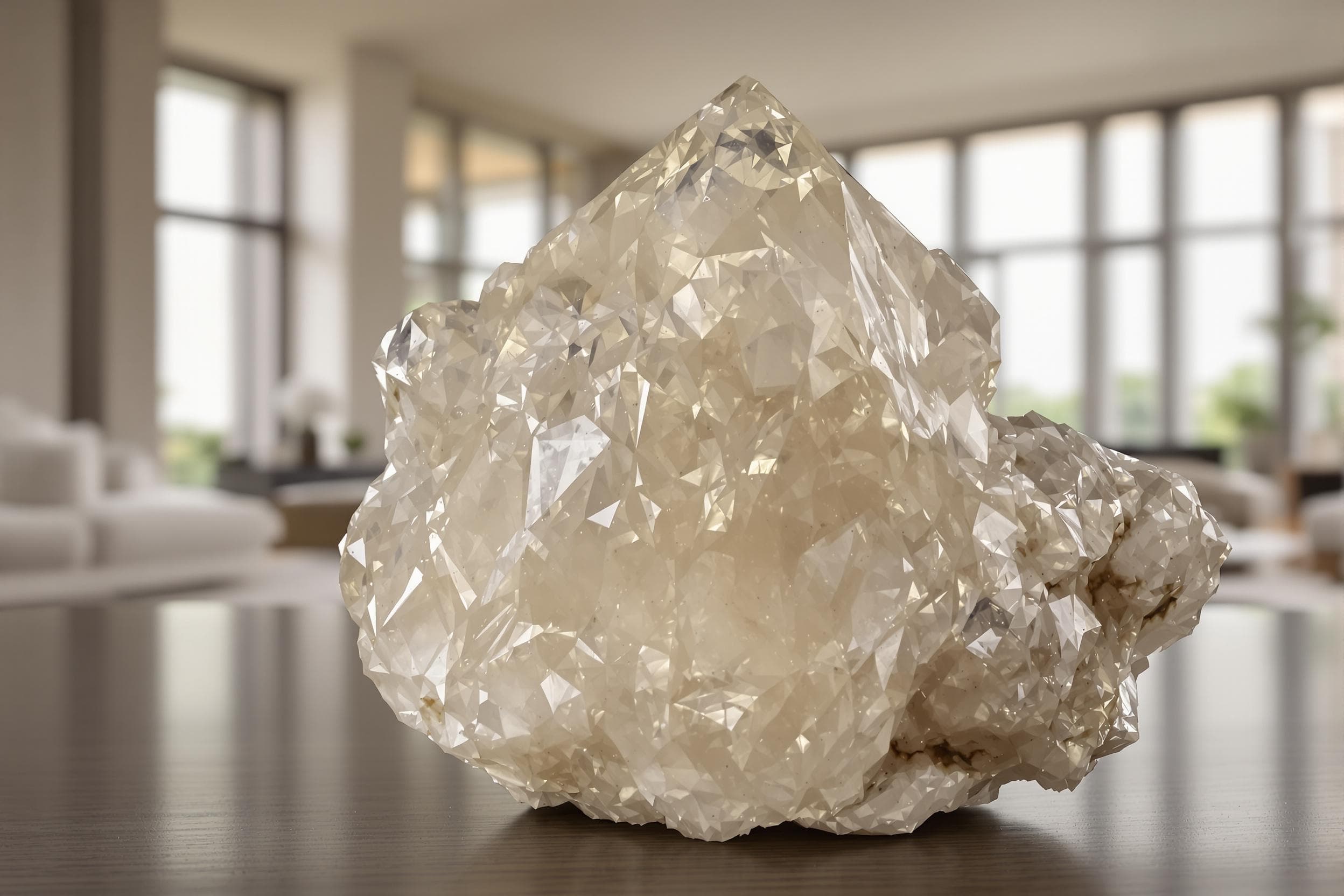
The Birth of Quartz: How Earth's Most Common Crystals Form
Quartz is not only the second most abundant mineral in Earth's crust - it's also one of the most fascinating. Its perfect hexagonal crystals emerge through a remarkable process that unites physics, chemistry, and geology. Dive into the science of quartz formation.
The Foundation: Silicon Dioxide and Its Secrets
Quartz consists of silicon dioxide (SiO₂) - a seemingly simple chemical compound that forms one of the most complex and versatile crystal structures in nature. The basic unit is a silicon atom surrounded by four oxygen atoms in a tetrahedral arrangement. These SiO₄ tetrahedra connect to form a three-dimensional spiral structure that gives quartz its characteristic properties.
The uniqueness lies in how these tetrahedra link: each oxygen atom is shared by two silicon atoms, resulting in the chemical formula SiO₂. This connection creates an exceptionally stable structure - so stable that quartz reaches a value of 7 on the Mohs hardness scale, making it harder than steel.
The Three Pathways of Quartz Formation
1. Igneous Crystallization: Born in Fire
The first and most dramatic type of quartz formation occurs in igneous processes. When silica-rich magmas like granite or rhyolite cool, quartz typically crystallizes as one of the last minerals from the melt. This happens at temperatures between 573°C and 870°C.
The crystallization process is fascinating: as the magma cools, silicon and oxygen atoms arrange themselves in the characteristic spiral structure. The cooling rate determines crystal size - slow cooling at great depth leads to large crystals, while rapid cooling at the surface produces microscopically small crystals.
2. Hydrothermal Processes: Hot Waters as Crystal Architects
The most spectacular quartz crystals often form through hydrothermal processes. Hot, mineral-rich water dissolves silicon dioxide from surrounding rocks and transports it through cracks and fissures. When the water cools or pressure decreases, the dissolved quartz crystallizes out.
These processes occur at temperatures between 50°C and 400°C. The special feature: slow crystallization from aqueous solutions enables the formation of exceptionally clear and well-formed crystals. The famous "Herkimer Diamonds" from New York and clear rock crystals from the Alps form this way.
3. Metamorphic Transformation: Pressure and Heat as Architects
The third pathway involves metamorphic processes. When quartz-bearing rocks are transformed under high pressure and temperature, existing quartz can reorganize and form larger, more perfect crystals. This process typically occurs at temperatures of 200°C to 700°C and pressures of several kilobars.
The Secrets of Crystal Structure
What makes the quartz structure so special? The answer lies in the combination of symmetry and flexibility. Quartz crystallizes in the trigonal crystal system and shows a remarkable property: chirality. Like DNA, quartz exists in two mirror-image forms - right- and left-handed.
This chirality arises from the spiral arrangement of SiO₄ tetrahedra. The spiral can wind either clockwise (right-handed) or counterclockwise (left-handed). This subtle property makes quartz piezoelectric - under mechanical pressure it generates electrical voltage, a property indispensable in modern technology.
The Role of Trace Elements: Color Through Impurities
Pure quartz is colorless and transparent - the classic "rock crystal." The many colored varieties arise from tiny amounts of trace elements incorporated during crystal formation:
- Amethyst: Iron ions (Fe³⁺) and natural radioactivity create the violet color
- Citrine: Iron ions in a different oxidation state and aluminum create yellow tones
- Rose Quartz: Titanium or manganese impurities give the pink coloration
- Smoky Quartz: Aluminum and natural radioactivity lead to brown to black tones
These "impurities" are often present in concentrations of only a few ppm (parts per million), yet show dramatic color effects.
Timescales of Crystal Formation
Quartz crystal formation spans completely different time periods:
- Laboratory quartz: Modern hydrothermal synthesis can grow crystals in days to weeks
- Geothermal quartz veins: Hundreds to thousands of years
- Alpine fissure crystals: Tens of thousands to hundreds of thousands of years
- Pegmatitic giant crystals: Millions of years
These enormous time differences also explain quality differences: slower crystallization leads to larger, more perfect crystals with fewer defects.
The Science of Nucleation
A particularly fascinating aspect is nucleation - the very first moment of crystallization. In a supersaturated solution, tiny crystal nuclei must first form before growth can begin. This nucleation is a statistical process that explains why some cavities contain perfect single crystals while others are filled with thousands of small crystals.
Nucleation is influenced by various factors:
- Degree of solution supersaturation
- Temperature and temperature fluctuations
- Presence of foreign particles as crystallization nuclei
- Vibrations and disturbances
Quartz as Geological Time Witness
Quartz crystals are extraordinary time capsules. Modern analytical methods can extract amazing information from quartz crystals:
- Fluid inclusions reveal the composition of forming solutions
- Trace element distributions indicate temperature and pressure conditions
- Cathodoluminescence makes growth zones visible and documents crystallization history
- Isotope ratios provide insight into material origins
The Future of Quartz Research
Modern research continuously expands our understanding of quartz formation. High-resolution electron microscopy shows details of atomic structure, while numerical simulations model the complex physicochemical processes. Particularly exciting are investigations into nano-quartz formation, which provide new insights into the earliest stages of crystallization.
Practical Significance
Understanding quartz formation is not only scientifically fascinating but also practically relevant:
- Synthetic quartz production for electronics and watch industries
- Exploration of new quartz deposits
- Quality assessment of natural crystals
- Environmental geology - quartz as indicator of hydrogeochemical processes
One Crystal, Infinite Possibilities
Quartz shows us how from the simplest building blocks - silicon and oxygen - through perfect orchestration of time, temperature, and pressure, true works of art of nature can emerge. Every quartz crystal is testimony to the elegant physical and chemical laws that govern our universe.
The next time you look at a quartz crystal, remember: you're looking at the result of a perfectly orchestrated molecular dance that has extended over millennia or even millions of years. In its clear structure are reflected the fundamental forces that shape our planet - from the atomic level to the mighty geological processes that move continents.
At Celestia, we understand the science behind beauty. Our quartz crystals are not just aesthetic objects, but windows into the fascinating world of geology and crystallography. Contact us for more information about our scientifically documented crystals.